 English
 Afrikaans
 Shqip
Shqip አማርኛ
አማርኛ العربية
 Հայերեն
 Azərbaycan dili
 Euskara
 Беларуская мова
 বাংলা
বাংলা Bosanski
 Български
 Català
 Cebuano
 Chichewa
 简体中文
简体中文 繁體中文
繁體中文 Corsu
Corsu Hrvatski
 Čeština
 Dansk
Dansk Nederlands
 Esperanto
 Eesti
Eesti Filipino
 Suomi
Suomi Français
 Frysk
Frysk Galego
 ქართული
 Deutsch
 Ελληνικά
 ગુજરાતી
 Kreyol ayisyen
 Harshen Hausa
 Ōlelo Hawaiʻi
 עִבְרִית
 हिन्दी
 Hmong
Hmong Magyar
 Íslenska
 Igbo
Igbo Bahasa Indonesia
 Gaelige
 Italiano
 日本語
日本語 Basa Jawa
 ಕನ್ನಡ
ಕನ್ನಡ Қазақ тілі
 ភាសាខ្មែរ
 한국어
한국어 كوردی
كوردی Кыргызча
 ພາສາລາວ
 Latin
Latin Latviešu valoda
 Lietuvių kalba
 Lëtzebuergesch
 Македонски јазик
 Malagasy
 Bahasa Melayu
 മലയാളം
 Maltese
 Te Reo Māori
 मराठी
मराठी Монгол
 ဗမာစာ
ဗမာစာ नेपाली
 Norsk bokmål
 پښتو
پښتو فارسی
فارسی Polski
 Português
 ਪੰਜਾਬੀ
 Română
 Русский
 Samoan
 Gàidhlig
 Српски језик
 Sesotho
 Shona
Shona سنڌي
سنڌي සිංහල
සිංහල Slovenčina
 Slovenščina
 Afsoomaali
 Español
 Basa Sunda
 Kiswahili
 Svenska
 Тоҷикӣ
 தமிழ்
தமிழ் తెలుగు
 ไทย
ไทย Türkçe
 Українська
 اردو
اردو O‘zbekcha
 Tiếng Việt
 Cymraeg
 isiXhosa
 יידיש
יידיש Yorùbá
 Zulu
Zulu

This tour will begin from the capital city of Delhi, ‘The City of Contradictions’ modern in New Delhi and ancient in Old Delhi. New Delhi is famous for wide roads, green avenues, and Old Delhi is famous for jam-packed bazaars in narrow lanes, rickshaw rides, and culinary delights. The next city of the visit will be Varanasi, ‘The Spiritual Capital of India’. People from far away carry the dead body of their loved ones to be cremated on the bank of the Holy River Ganga as in their belief, cremating the body there will pave the way to salvation after that is Khajuraho, the symbol of celebration and enjoyment of life.
Read more…
Departure from Delhi and the Trip Calls off at Goa.
As per schedule
Arrive in Delhi, and you will be met with our representative at the airport and transferred to the hotel.
After taking some rest, visit Laxmi Narayan Temple, Government buildings like President House, Parliament House (from outside), India Gate (War Memorial), and Jama Masjid or the Grand Mosque in the old city of Delhi.
After visiting Jama Masjid, embark on a walking tour of narrow lanes of Old Delhi with the addition of the Spice market. Overnight stay will be in Delhi.
On this day morning is free. In the afternoon, we will be boarding an overnight train for Varanasi. It will take approximately twelve hours.
We will be reaching Varanasi (Spiritual Capital of India) early in the morning. Transfer to Hotel.
It is the oldest living city in the world. The narrow lanes of this city reverberate with holy chants of Mantras from the spiritual scriptures in the morning, along with the sound of blowing the conch shell. Evenings are marked with Aarti (Religious Ceremony using flowers and lamps) or worship of Holy River Ganga at Ghats. The lanes are full of treasures from the Vedas and Upanishads. The ancient scriptures of Hinduism are taught at various centers in this holy city. Early morning the yoga session at the river bank is an exciting sight. The Ghat or the river bank offers the cremation sight and the way of life of the people of this ancient city. It is associated with music, dance, and brilliant crafts; Banarsi Saree is world-famous for its suppleness and excellent quality.
We will be undertaking a walking tour of this beautiful city to explore the intrigue and various aspects of spirituality along with the cremation Ghat for Hindus. People from distant parts of India bring the bodies of their loved ones to get cremated in Varanasi. In Hinduism, it is believed that cremating a body in Varanasi will absolve the soul from the circle of life and death. In the evening, we will again visit Ghat to witness the Aarti. Overnight night stay will be in Varanasi.
Early in the morning, we will take a boating tour on the river Ganges to witness the exciting sunrise. In the evening, we will board a train for an overnight journey to Khajuraho, which will take around ten hours.
The celebration and enjoyment of life are depicted in many forms through sculptures from the ancient Hindu scripture of Kamasutra on the World Heritage Site of Khajuraho Temples. During that time, continued conflicts and battles used to rage, and the population kept dwindling. Sex, as the means, was propagated through erotic sculptures on the walls of temples to increase the number of local people, which was the must-visit place for the people in their daily lives.
Here we will visit the Eastern and the Western Group of temples. Overnight stay in Khajuraho.
We will start in the morning for Jhansi. On the way, we will visit Orchha, the hidden fort. From Jhansi, we will board a train for Agra.
Orchha: It was founded in 1501 AD by the Bundelas Rajputs clan and is an excellent example of Hindu Architecture on the banks of river Betwa in Uttar Pradesh. It has got a rugged fort with the addition of beautiful palaces and courtyards with impressive cenotaphs. The panoramic view from the top of Uth Khana or stable for the camels is unique along with the Jahangiri Mahal or the king’s private chamber. After the visit to Orchha, we will catch a train for Agra, and it will take around 4hours to reach. Transfer to hotel, and after taking rest, we will be visiting the Taj Mahal.
Taj Mahal: Emperor Shah Jahan built the Taj Mahal in memory of his wife, Mumtaz Mahal. The Taj Mahal has got the uniqueness that it gives different impressions at different times of the day. It took twenty-two thousand workers, twenty-two years to build this unmatched work of art with only simple tools like a chisel and hammer. It is built on a Persian design with four gardens in the Mausoleum’s front and four minarets on the four corners. It is the most symmetrical building in the world. Precious and semi-precious stones are embedded for their ornamentation, which shines when it comes to sunlight. Overnight stay will be in Agra.
Early in the morning, we will proceed for Jaipur, and on the way, we will visit Fatehpur Sikri (The Ghost City).
Fatehpur Sikri: This city is also known as Ghost City as it took eight years to complete but had to be abandoned within six years due to lack of water. It was built by Emperor Akbar, who got a son with the blessing of Holy Saint Shaikh Salim Chishti, who was residing in the vicinity. If the Taj Mahal is famous for its beauty, Fatehpur Sikri is famous for its art and architecture. Here we will visit various palaces with intricate carvings, Panch Mahal and Buland Darwaza. Emperor Akbar had vowed to raise the height of the Southern Gate of the mosque if he could crush the rebellion in the south, and it would be the highest gate of the world; this is how the southern entrance of the mosque became the highest gate of the world.
Jaipur: On reaching Jaipur, transfer to the hotel for rest. It is the first planned city of India and is the masterpiece of Bengali architect Vidyadhar Bhattacharya. Raja Sawai Jaisingh founded it. It is called the Pink City because all the government buildings, crossroads, residential complexes, and bazaars are painted pink. Here we will visit Hawa Mahal or Wind Palace, used by the Royal Ladies to observe the victory and festive processions, City Palace, the administrative headquarters of erstwhile Jaipur State, for its impressive palaces and pavilions and the Observatory. Afterward, take a walking tour of the market of Jaipur where you will find people in colorful attire, shops selling traditional textiles and various ware, roads will be full of multiple kinds of transport like rickshaws, cars, camel carts, and buses. Overnight stay will be in Jaipur.
On this day, one can undertake a fabulous hot air ballooning optional experience over Jaipur, which will cost 285 USD extra but will be a lifetime experience. The forts, bazaars, villages, and desert will be an electrifying experience from the Balloon ride.
We will visit Amer Fort. Maharaja Man Singh built it. It is an enchanting complex of beautiful gardens, Halls, Pavilions, and royal mansions and is an excellent example of Indo-Mughal architecture. The view from the upper story of Amer Fort is just out of the world. We will visit Jal Mahal, the summer retreat of Maharaja, for a photographic session on our return to the hotel. After that, we will undertake a walking tour of the market with great shopping opportunities, know about the culture, art, and understand the life of the simple citizens of Jaipur. In the night, we will board an overnight train to Jaisalmer.
On arrival at Jaisalmer, transfer to hotel for some rest.
Jaisalmer, the desert city of Rajasthan, is also famous as the Golden City situated in the Golden sands of the Thar Desert has the charisma of its own.
After taking complete rest after the night journey from Jaipur, in the afternoon embark on the adventure of camel safari, the landmark adventure activity of this tour. Leave your luggage at the hotel and proceed for an overnight camel safari and a night stay in the desert camp. The jeep will take us 20 km inside the desert, and after that, we will take a one-hour camel safari. During travel, we will halt at Kalbelia Village (The desert tribe). One can interact with them regarding life in the desert, traditions, and priorities. Watch stunning sunset in the desert and take dinner under the stars, overnight stay in the desert.
Please note: The population and tourists visiting Jaisalmer have blown off to gigantic propositions. It is too old to cater to the ever-increasing population of residents and tourists preferring to stay inside the fort due to which it is crumbling, and the primary source of income for the people is tourism. If anything goes wrong with this magnificent work of art and craftsmanship, the life of the local population of this Golden City will be affected.
Hence, deliberately, we have kept our night stay at the hotel outside the fort.
Take breakfast and watch the sunrise in the desert and return to Jaisalmer. After freshen up at the hotel and rest, visit Jaisalmer Fort.
The name of the founder Rawal Jaisal and Mer means hill, and this is how the name of the fort Jaisalmer was coined. It is made up of Golden sandstone, and when it comes in contact with the early morning sun rays, it shines. It is because of this fact it is called the Golden Fort.
Visit Patwon Ki Haveli with elaborate carving work, Museum the exemplary cultural artifacts, and Jain Temple in Jaisalmer Fort. The night stay will be in Jaisalmer.
Transfer to Jodhpur by train from Jaisalmer early in the morning, and It will take around six hours. Transfer to hotel for some rest and after that visit Mehran Garh Fort, Toor Ji ka Jhalar and Ghanta Ghar( The local market of Jodhpur)
Mehran Garh Fort: it was built by Rao Jodha Ji. It has got a superb structural design. Palanquins pavilion is a must-visit. As there was no motor transport at that time, Palanquins were carried by the men to transport royal ladies from one place to another. The armory of bygone days is well preserved. The museum of this fort is also very well maintained. From this fort, one can observe why Jodhpur is called the Blue City of India.
Toor Ji Ki Jhalra: It is a step-well built-in 1740 for the conservation of rainwater and can be called a reservoir for water harvesting as the state of Rajasthan is water deficient. It is prohibited to swim in this step well as it is 200 feet deep and can endanger one’s life.
Ghanta Ghar: (The clock tower) It is situated right in the center of Jodhpur. Locals and foreigners frequent this place to get the feel of the city as one can find ladies in colorful fabrics bargaining for goods for daily consumption of household and tourists watching their skills and appreciating the overall scenario. Overnight stay will be in Jodhpur.
Early in the morning, we will proceed to Udaipur, the white city of Rajasthan, and on the way, we will visit the Jain temple at Ranakpur. On reaching Udaipur (The White City), transfer to hotel for rest. After taking a rest day, is free to visit local markets and various cafes in Udaipur. Overnight stay will be in Udaipur.
Udaipur: It is also known as the White City of Rajasthan. Many temples, lakes, and palaces with intricate carvings and frescoes are present in Udaipur. Maharaja Udai Singh of Mewar founded it. It is renowned for its artificial lakes, Palaces, architecture, gardens, temples, and museums.
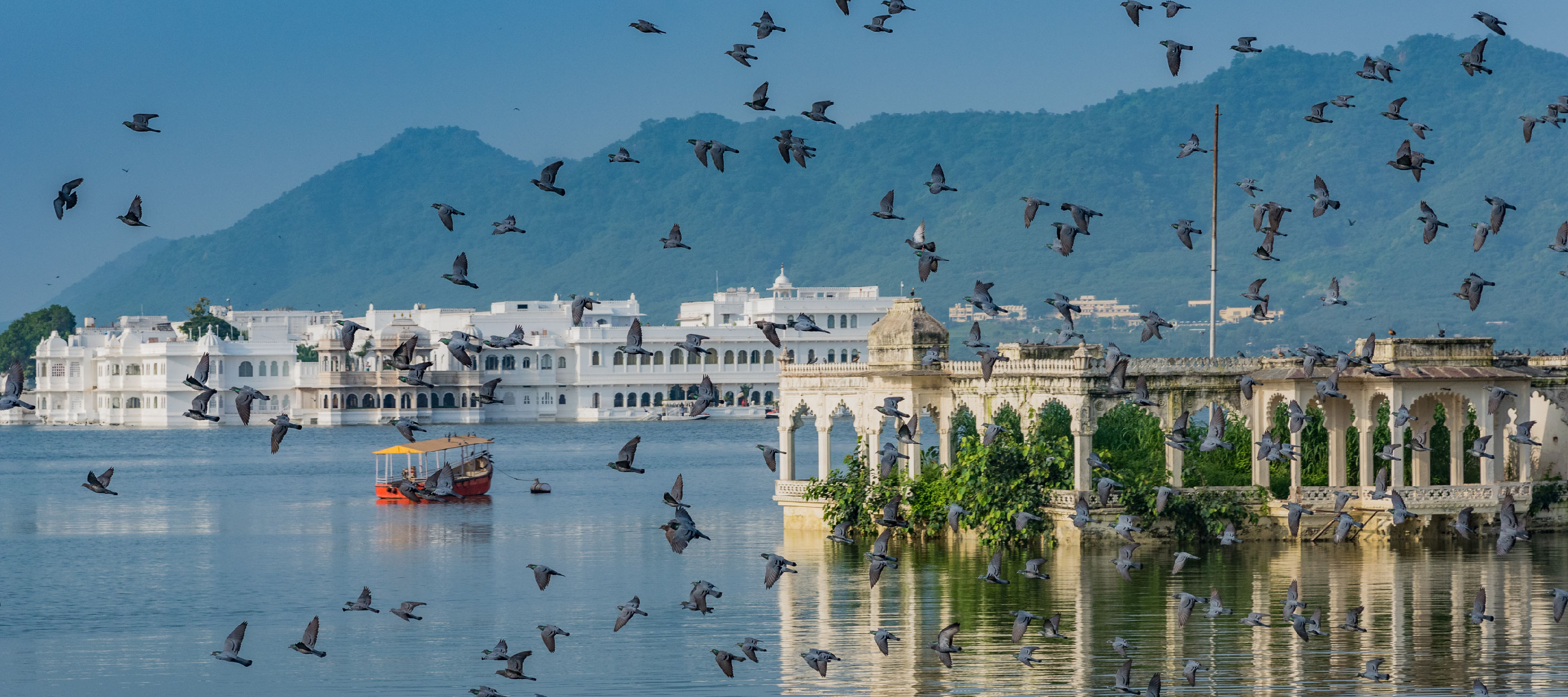
Visit City Palace very well maintained and one of the enormous Palaces of Rajasthan. Maharana Udai Singh shifted his capital from Chittaur Garg to Udaipur on the advice of an astrologer to build this beautiful piece of art and architecture. The 22 generations have upgraded this palace as per their wishes to its present grandeur in the last 400 years. There are so many palaces and mansions inside the City Palace, and observe the stunning views of Udaipur, the white city, Lake Pichola, and Lake Palace in the middle of the lake from numerous portholes of this magnificent palace. It will undoubtedly be an enchantment for photography-loving people.
We will take a boat ride. It will last for 25 minutes, take us to Jag Mandir and around City palace. After that, get on a walking tour of Udaipur, covering narrow lanes of Udaipur City. It will start from Jagdish Temple in the middle of the old city of Udaipur, and the last attraction will be the Rajasthani Folk Dance performance at the very well restored Dharohar Ki Haveli. Night Stay will be in Udaipur.
On this day, we will take an early morning flight to Mumbai. On arrival at Mumbai, transfer to the hotel. After taking some rest, transfer to Gate Way of India to catch a Ferry to Elephanta Caves.
Elephanta: It is an island off the coast of Mumbai. The caves came into existence in the 6th century AD and are dedicated to Lord Shiva, the purifier of this universe. The ferry will take 25 minutes to reach Elephanta caves from the Gateway of India. It is a UNESCO World Heritage Site. Seagulls will accompany you on the journey to caves. While returning from Elephanta caves, the view of the Gateway of India and the skyline of Marine Drive is quite incredible. We will be staying in Mumbai on this night.
Gateway of India: In the evening, visit the Gateway of India built by the British. It signifies the landing of British Emperor George V, the first English Royal to come to the shores of India in the year 1924. The Arabian Seafront in South Mumbai Gateway of India is situated.
Visit Marine drive in the night when it resembles a necklace of pearls due to all the street poles lights. The sense of calm, loose-up atmosphere, enthralling sunset by the ocean provide personal tranquility and content.
The local population spends some quality time here in the evening, and joggers visit this place in the morning, after dinner return back to the hotel for an overnight stay.
Early in the morning, visit Dhobi Ghat at Mahalakshmi. The open laundry of Mumbai, one can see millions of clothes hanging out there. The hotels, hospitals, and the household of Mumbai send their laundry to this place, and it is returned the next day, clean and crisp without the help of machines and with the efficient process. The process is performed by around 250 families doing this work from generation to generation. The collection of clothes, segregating them into colored and white, washing, drying, and ironing is remarkable. At any time, one can see hundreds of washer men at work, and it is a delight for the eyes of photography enthusiasts around the world. It is a fascinating experience to watch and observe how they do it. First, they soak the clothes in water in the large tubs and beat the dirt out of clothes after some time. The different colored clothes are isolated, i.e., white with white, green with green, blue with blue, and yellow with yellow.
It is the only place in the world where you can witness such activity and in a very organized fashion. After a visit to the Dhobi Ghat, the day is free. In the evening, catch an overnight train/ sleeper bus to Goa.
Arrive in the morning in Goa. Transfer to the hotel. After the rest visit famous beaches and churches in Goa, overnight stay will be in Goa.
Tour ends. If informed in advance, Adventure Delight can make your further arrangements.
Available dates for booking: 2022-07-17, 2022-08-21, 2022-09-18, 2022-10-02, 2022-10-09, 2022-10-16, 2022-10-23, 2022-11-06, 2022-11-20, 2022-11-27, 2022-12-04, 2023-01-01, 2023-01-08, 2023-01-15, 2023-01-22, 2023-02-05, 2023-02-12, 2023-02-19, 2023-02-26, 2023-03-05, 2023-03-12, 2023-03-19, 2023-03-26
Ans. The weather in Goa is perfect from October to March. The climate during this time is neither too hot nor too cold, making it the ideal visiting time for tourists.
Ans. Goa is approximately 1926 km from Delhi.
Ans. Basilica of Bom Jesus, Se Cathedral, Church and Convent of St. Francis of Assisi, St. Cajetan Church are some of the well-known churches in Goa.
Ans. Yes, Delhi to Goa Adventure is safe for female solo travelers as an experienced tour manager is deputed for every tour.
Ans. One can enjoy the complete experience of the Delhi to Goa trip in eighteen days.
Ans. The places covered in Delhi to Goa tour include:- Varanasi, Khajuraho, Orchha, Agra, Jaipur, Jaisalmer, Jodhpur, Udaipur, Mumbai, and Goa in eighteen days.
Ans. Yes, it takes you from the northern part of India cruising through spiritual destinations, Mughal cities, Land of Maharajas, Desert safari, Business capital of India to the pristine beaches and ancient churches of Goa in the shortest possible time and on a pocket-friendly budget.
Ans. Calangute beach, Basilica of Bom Jesus Church, Fort Aguada, Baga Beach are some places one should not miss when in Goa.
Ans. Cashew nuts, Spices, handicrafts, and Cashew Feni are some things one can buy in the local Goa market.
Ans. The most popularly celebrated festivals in Goa are Christmas, Easter, Ganesh Chathurthi, Carnival, and the feast of St. John, the Baptist.
Ans. Deltin Royale is the most preferred casino in Goa.